This section of our website requires Adobe Flash Player v8 or above. Click here to download/upgrade now.

ABOUT THE SHOW


New Adventures’ much loved production of Tchaikovsky’s Nutcracker! is one of the most popular dance productions ever presented in the UK. It completed its most recent Tour in May 2008.

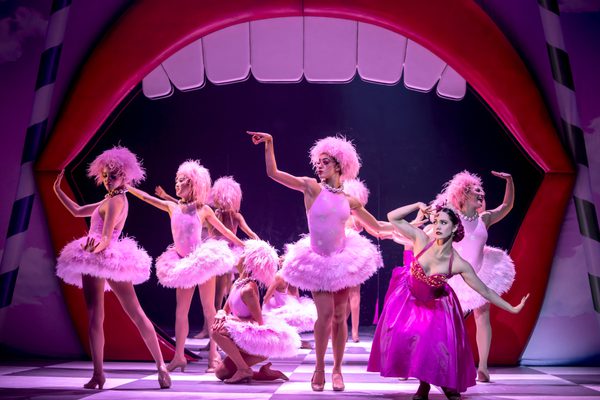
This delicious theatrical feast has family sized helpings of Matthew Bourne’s trademark wit, pathos and magical fantasy. Nutcracker! follows Clara’s bittersweet journey from a hilariously bleak Christmas Eve at Dr. Dross’ Orphanage for waifs and strays, through a shimmering, ice-skating, winter wonderland to the scrumptious candy kingdom of Sweetieland.

Tchaikovsky’s glorious score and Olivier award winning designer, Anthony Ward’s unforgettable sets and costumes combine with sizzling choreography to create a fresh, hip and charmingly irreverent interpretation of the traditional Christmas favourite that will delight the whole family.

OFFICIAL SHOW WEBSITE - CLICK HERE


MATTHEW BOURNE ON NUTCRACKER!

Tchaikovsky’s Nutcracker is over 115 years old and it remains incredibly popular. In its original form Nutcracker can be tricky to understand – have you done anything to the story to make it more accessible?

I would like to think that the main reason that Nutcracker has retained its perennial appeal is because of Tchaikovsky’s incredible score. Act one contains some of his most engaging and, at times, profound story-telling music and Act Two has one glorious melody after another. After 115 years it retains its mystery, magic and the power to transport us to another world.

The Nutcracker also tells a simple story very clearly.  It’s a wish fulfilment story – a story with a heroine who has a lot to overcome and who eventually gets her man.  It’s about growing up and first love and these are things we can all relate to, I think this is why it remains so popular. 

It can however be a difficult story to follow and a bore for the men of the family. I’ve tried to tell a story for all the family. Adults and kids should all find something to thrill them and touch them in Clara’s adventure and engaging the people of today was so much behind the production.  My version appeals to a contemporary/ young audience as well as the older audience because, I think, the characters are people you can identify with.  The more I see ballet versions of young boys in tights and rows of girls in frilly dresses and then look at the young people of today, the more I think ‘how does it relate to them’?  Audiences need a show to relate to them on a deep level.  One of the things I thought would work really well with this piece was for the dancers to play children as you win over everyone: it makes the adults remember being young, everyone is nostalgic, and the young audience can see the adults playing children on stage, being a bit naughty, and finding that incredibly funny. 

Can you talk a little about how you used music to tell a story?
With a piece such as Nutcracker, which has a clearly defined story that already exists, I really listen to what the music is saying, try to open my mind up to what different ideas it could be conveying.  Certain pieces of instrumentation will speak in some way and different characters will emerge.  I try to interpret the music deeper than just counting the dance steps by using all the nuances of the music to bring out the characters and find aspects of the music which feel like voices of the people in the piece.

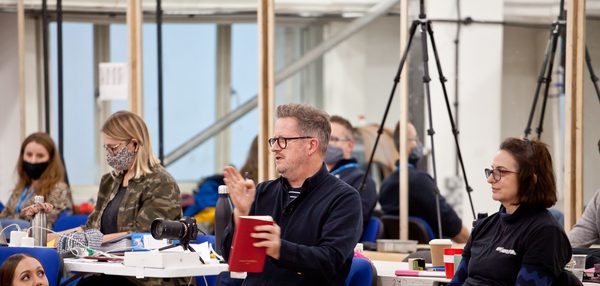
Describe the rehearsal process.  Are there any new dancers in this Nutcracker!?  How do they fit into the production and how have they changed the production?
For the rehearsal process we begin with a movement workshop and start by teaching the piece as it was when last danced.  The show changes a lot according to who’s performing but the basic choreography is taught.  This time we have some people who have danced Nutcracker! many times before and some people who are brand new to it, and that’s always a good mix for me.  New people naturally bring new aspects to the show as they are individuals.  They start to suggest new story ideas, new movement, and new connections. It also means that the experienced people will give an indication of what the show is and how to perform it while the new dancers will bring in a freshness, new ideas and energy that will affect the dancers who have been around for a while.  You get this great mix that actually lifts both sides of the company up. 

Nutcracker! is a more difficult show to do than it appears, its larger than life and its easy to go over the top with that and one of my jobs is to keep pulling it back so that its rooted in a reality, you need to feel something for the characters.  For example, In Act One the dancers are playing kids and quite often people get this wrong to begin with, start acting silly/childish and actually kids aren’t really like that.  They can be funny but the audience needs to feel something for them.  The dancers who are familiar with Nutcracker! are able to pass this on.


How did you work with Anthony Ward to create the colourful characters that appear in the show?

Anthony Ward and I, with Martin Duncan who originally worked with us on the concept for the show, devised the characters together and searched for a parallel to the original piece.  We always wanted to find something that reflected the piece that people know.  Most Nutcrackers are completely different to ours and sometimes difficult to follow but we wanted our story to make sense and give people what Nutcracker needs to give you in terms of the big moments and interpret that in a completely new way.  I think that once we had the idea of a darker/monochrome world in Act One going into a techincolour world that gave Anthony full reign to decorate the production with full colour.  Those colours were liquorice allsorts colours. Over the years we have worked on Nutcracker! we have toned down the colours and made them work better together as a group.  Colour and outrageous shapes can be fun but you need to be able to dance and you need to be able to see them together and it not be too overpowering – you need to get the balance right.  It’s interesting how the show was received in America – they want their Nutcracker! to be traditional.  In the UK we are not as strongly tied into seeing Nutcracker in a particular way and as such my production has gone beyond the audience which would go to Nutcracker every year any way. 

The famous “Snow flakes” sequence which ends Act One is transformed into a glorious “Ice-Skating” extravaganza in your staging. What was the inspiration for this?
There are certain things that every production of Nutcracker should deliver – the growing Christmas Tree, the transformation of the Nutcracker into a young man and the falling of snow during the “snowflakes” sequence. Everyone feels a sense of childlike pleasure when snow begins to fall and I wanted to try and capture that sense of pure joy seen through the eyes of the orphan children. So, rather than depict the snowflakes themselves, as in the classical version, I have the Orphans skating across a frozen pond as an exhilarating expression of their newfound freedom. The idea, however, came not from Torvill and Dean, much as I love them, but from the 30’s movie skating star, Sonje Henie. For me she is the perfect image of Princess Sugar and Anthony Ward certainly found inspiration in her many and varied skating ensembles.

One of the highlights of the Petipa/Ivanov original is always the suite of National Dances that are staged for Clara’s edification in The Land of The Sweets for which you created new characters.
One of the pleasures of creating these characters was to link them with their orphanage counterparts. In Clara’s imagination her friends become the fluffy Marshmallow girls, the yobby Gobstopper boys, the vain Liquorice Allsort trio and the lewd and sticky Knickerbocker Glory! Her best friends, the twins, become her heavenly helpers, The Cupids. Dr and Mrs Dross transform into the gluttonous rulers of Sweetieland, King Sherbet and Queen Candy, and their bratish children, Sugar and Fritz, grow up into the glamorous Princess Sugar and saucy Prince Bon Bon. Everything is edible in Sweetieland and its inhabitants are judged not by how they look but by how they taste!  

How will this production differ from the production that was last seen in the UK?

This is very much a new production. It stays pretty close to the 1992 scenario written by Martin Duncan and myself, however, the show was substantially re-choreographed in 2002 and Anthony Ward took a fresh look at his memorable designs. In fact, our aim was to take a fresh look at every aspect of the show whilst retaining the innocence and charm of the original production. Fifteen years on I find Tchaikovsky’s music more and more profound, its magic turns us all into kids again.  

Why is your Nutcracker! a joy to watch year round?
Luckily, we didn’t want the Christmas aspect to be like it is in the original.  Although it is set on Christmas Eve it doesn’t really feel Christmasy, in fact it’s a rather sad Christmas – you don’t feel like you are in the Christmas spirit to begin with!.  Nutcracker! is a much more universal story about these orphans escaping from this institutionalised life.  It doesn’t read as a Christmas show unless you are sitting watching it the week before Christmas.  It does have a snow scene and ice skating but you can have that any time of year.  On our first British tour it surprised me initially that we were still performing past Easter, but I looked at it again and realised there is no reason why it should only be seen at Christmas.  We had a snow storm in Edward Scissorhands and it never worried people in the heatwaves of Summer!

Why is it important to you to keep coming back to venues with shows?

We always try to return to venues every year, and pick up new theatres along the way, so we can develop our audiences.  What we have seen, in a very genuine way in the last few years, is that in regularly visited venues people have come back to all our shows, they want to see our next production, and this made me look at my work differently.

I used to think that the audiences came to see our shows because it was a Nutcracker production, or a Swan Lake but then Highland Fling, Play Without Words and even Edward Scissorhands, all of which are not famous dance pieces, still had audiences - people would automatically feel comfortable with these productions because of the company behind the show.

Now audiences are coming to see the company and my work rather than the production, they want to see what the next thing is.  I have started to respect the audience even more as they seem to be trusting me more and more to give them a good night out. Therefore we will keep coming back to these venues and I hope that people who saw Nutcracker! a few years ago will want to return to the show with new or grown up children, nephews, nieces.  Hopefully people will remember it is a great night out that they can bring the family to and a whole new generation of people will now have the opportunity to see it.